



How Do I Calculate My Break-Even Point?
Understanding your break-even point is one of the most important parts of running a profitable business. Whether you are starting a new business, introducing a new product, or reviewing your pricing, knowing your break-even point can help you make smarter financial decisions and improve cash-flow management.
Your break-even point is the point where your business income exactly covers your business costs. In other words, you are not making a profit, but you are not making a loss either. Once your sales go beyond your break-even point, your business starts generating profit.
For many business owners, calculating break-even point provides valuable insight into:
- How much revenue is needed to cover costs
- Whether pricing is sustainable
- How sales targets should be set
- The impact of rising expenses
- Whether a new product or service is financially viable
Contents
- What Is the Break-Even Point?
- Understanding Fixed And Variable Costs
- What Is Contribution Margin
- Break Even Point Formula
- Seasonal Businesses And The Break Even Point
- How To Calculate Break Even Revenue
- Simple Break Even Chart Example
- Why Calculating Your Break Even Matters
- Common Mistakes When Calculating Break Even
- How Management Reporting Can Help
What Is the Break-Even Point?
The break-even point is the amount of sales required for total revenue to equal total expenses.
At this point:
Revenue = Expenses
Your business has covered:
- Fixed costs
- Variable costs
But has not yet generated a profit.
Understanding this number helps business owners set realistic goals and make informed decisions about pricing, staffing, marketing, and growth.
Understanding Fixed and Variable Costs
Before calculating your break-even point, it is important to understand the difference between fixed costs and variable costs.
Fixed Costs
Fixed costs stay relatively the same regardless of how many sales you make.
Examples of fixed costs include:
- Rent or lease payments
- Insurance
- Salaries
- Accounting fees
- Software subscriptions
- Loan repayments
- Phone and internet
Even if your business makes no sales, these costs still need to be paid.
Variable Costs
Variable costs change depending on how much you sell or produce.
Examples of variable costs include:
- Materials
- Packaging
- Freight
- Manufacturing costs
- Merchant fees
- Sales commissions
The more products or services you sell, the higher your variable costs generally become.
What Is Contribution Margin?
Contribution margin is the amount of money left from each sale after variable costs have been deducted. This remaining amount contributes toward covering fixed costs and eventually generating profit.
For example:
- Selling price = $100
- Variable costs = $40
- Contribution margin = $60
That $60 contributes toward paying your fixed business expenses.
Understanding contribution margin is important because businesses with higher margins generally reach their break-even point faster.
Break-Even Point Formula
The standard break-even point formula is:
Break-Even Point (Units) = Fixed Costs divided by (Selling Price Per Unit less Variable Cost Per Unit)
This formula calculates how many units you need to sell before your business starts making a profit.
Example of a Break-Even Point Calculation
Let’s say your business sells candles.
Your costs are:
- Fixed costs = $5,000 per month
- Selling price per candle = $40
- Variable cost per candle = $15
Using the formula:
Break-Even Point (Units) = Fixed Costs divided by (Selling Price Per Unit less Variable Cost Per Unit)
Your calculation becomes:
$5,000 ÷ $25 = 200
This means you need to sell 200 candles per month to cover your costs and break-even.
Any sales above 200 candles contribute toward profit.
Break-Even Point Example With GST
New Zealand businesses registered for GST should generally calculate break-even point using figures excluding GST.
For example:
- Sale price including GST = $115
- GST-exclusive sale price = $100
Because GST collected is paid to Inland Revenue, it is not considered true business income.
Using GST-exclusive figures helps provide a more accurate understanding of actual profitability and cash-flow.
Seasonal Businesses and Break-Even Point
Many New Zealand businesses experience seasonal fluctuations throughout the year. Businesses in tourism, retail, agriculture, and hospitality often have periods where revenue is significantly higher or lower.
This means your break-even point may vary during different times of the year.
For example:
- A retail business may exceed break-even comfortably during Christmas
- A tourism operator may rely heavily on summer income
- A farming business may experience irregular cash flow cycles
Understanding seasonal trends can help businesses:
- Budget more effectively
- Prepare for quieter months
- Manage cash reserves
- Forecast staffing needs
How to Calculate Break-Even Revenue
You can also calculate your break-even point in terms of sales dollars rather than units.
The formula is:
Break -Even Revenue = Fixed Costs divided by Contribution Margin Ratio
The contribution margin ratio is the percentage of each sale remaining after variable costs are deducted.
This can be especially useful for service-based businesses where measuring individual units may not be practical.
Simple Break-Even Chart Example
A break-even chart visually shows where your revenue and expenses meet.
Typically:
- The horizontal axis represents sales volume
- The vertical axis represents revenue and costs
- The break-even point is where the total revenue line crosses the total cost line
Below the break-even point:
- Your business is operating at a loss
Above the break-even point:
- Your business is generating profit
Break-even charts can be very useful in management reporting because they make financial performance easier to understand at a glance.
Simple Break-Even Chart Example
The chart below shows how revenue increases as sales grow, while fixed and variable costs combine to create total costs. The point where the revenue line crosses the total cost line is the break-even point.
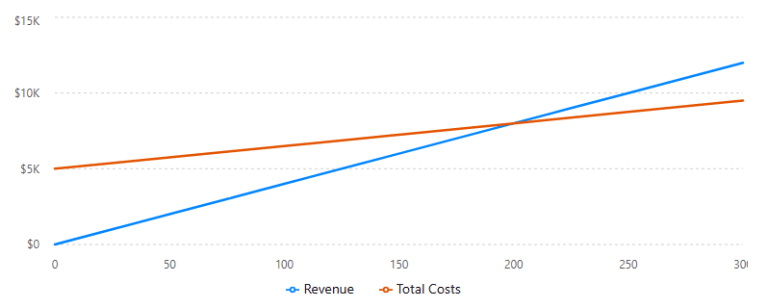
At 200 units sold, the revenue and total cost lines intersect. This is the break-even point – the stage where the business has covered all costs but is not yet making a profit. Beyond this point, additional sales contribute toward profit.
Why Calculating Your Break-Even Point Matters
Calculating your break-even point can help you:
Set Realistic Sales Targets
Knowing exactly how much revenue is needed to cover costs helps you establish achievable monthly and annual goals.
Improve Pricing Decisions
If your break-even point is too high, it may indicate your pricing needs adjusting or your costs need reviewing.
Manage Cash Flow Better
Understanding your cost structure helps improve forecasting and cash flow management.
Make Better Business Decisions
Break-even analysis can help when:
- Hiring staff
- Purchasing equipment
- Expanding premises
- Launching new products
- Reviewing profitability
Identify Financial Risks Early
If sales drop below your break-even point, you can quickly identify the need to reduce expenses or improve revenue.
Common Mistakes When Calculating Break-Even Point
Forgetting Smaller Costs
Small recurring expenses such as software subscriptions, bank fees, and insurance can add up quickly.
Underestimating Variable Costs
Freight, packaging, and transaction fees are often overlooked.
Using Incorrect Pricing
If discounts or promotions are common, your actual selling price may be lower than expected.
Not Reviewing Calculations Regularly
Costs change over time. Your break-even point should be reviewed regularly as expenses, wages, or supplier pricing increase.
How Management Reporting Can Help
While basic break-even calculations can be done manually, many businesses benefit from more detailed management and business reporting.
Regular financial reporting can help you:
- Monitor profitability trends
- Understand margins
- Track business performance
- Forecast future cash flow
- Identify issues before they become serious
Having accurate, up-to-date financial information makes it much easier to make informed business decisions.
Working with a qualified accountant can also help ensure your break-even calculations are accurate and based on reliable financial data. This becomes especially valuable as businesses grow and become more complex.
Need Help Understanding Your Business Numbers?
Understanding your break-even point is a valuable first step toward improving profitability and cash flow. However, many business owners find that ongoing management reporting and financial analysis provide even greater insight into how their business is performing.
At DNA, we help businesses better understand their financial position through accurate reporting, practical advice, and clear business insights. Whether you need help with budgeting, forecasting, cashflow management, or management reporting, our team can help you make informed business decisions with confidence.
FAQ: Break-Even Point
What is a good break-even point?
A lower break-even point is generally better because it means your business needs less revenue to cover expenses. However, what is considered “good” varies between industries.
Is break-even point the same as profit?
No. The break-even point is where income equals expenses. Profit only begins once sales exceed the break-even point.
How often should I calculate my break-even point?
It is a good idea to review your break-even point regularly, especially if pricing, wages, supplier costs, or overheads change.
Can service businesses calculate break-even point?
Yes. Service businesses can calculate break-even point using revenue targets, hourly charge-out rates, or contribution margins.
Why is break-even analysis important for small businesses?
Break-even analysis helps small businesses understand how much they need to sell to remain financially sustainable and profitable.
Should GST be included in break-even calculations?
Generally, GST should be excluded from break-even calculations because GST collected is payable to Inland Revenue and is not true business revenue.

Need Help Understanding Your Business Numbers?
Contact DNA to discuss how better management and business reporting can support your business growth.

